Most people are not truly afraid of being alone. They are afraid of what becomes audible when everything else becomes quiet.
When the conversations stop, the television is turned off, the music fades, and the phone is placed out of reach, we are left with something modern life rarely asks us to face directly: ourselves.
At first, solitude may not feel peaceful. It may feel restless, awkward, or strangely empty. Thoughts begin appearing without invitation. Old conversations replay themselves. Unanswered questions rise to the surface. Emotions we have postponed begin asking for our attention. The mind starts reviewing yesterday, rehearsing tomorrow, and searching for something—anything—to fill the silence.
We may call this boredom, but often it is something deeper. It is the discomfort of meeting the parts of ourselves that have been hidden beneath constant activity.
The World Has Made Distraction Feel Normal
We live in a time when almost every silent moment can be filled immediately. While waiting in line, we reach for the phone. While eating, we watch something. While driving, we play music or listen to a podcast. Even while resting, we scroll through the lives, opinions, achievements, and appearances of other people.
There is nothing inherently wrong with entertainment, technology, conversation, or companionship. They enrich our lives in many ways. The problem begins when we can no longer remain peacefully with ourselves without them.
When every pause must be filled, distraction is no longer simply something we enjoy. It becomes something we depend upon to avoid inner contact. The phone then becomes more than a communication device. It becomes a doorway away from ourselves.
We instinctively reach for it whenever silence threatens to reveal what is happening within us. A notification offers a temporary escape from an uncomfortable emotion. A video interrupts a difficult thought. Social media allows us to enter other people’s lives so that we do not have to examine our own.
But what we repeatedly avoid does not disappear. It waits beneath the surface and quietly influences our reactions, relationships, choices, and sense of identity.
What Are We Really Avoiding?
When people say they do not enjoy solitude, they may believe they are avoiding loneliness. But sometimes what they are avoiding is the unedited version of themselves.
In the presence of others, we are often performing a role. We are the parent, partner, nurse, friend, professional, provider, leader, or person who appears to have everything under control. These roles are necessary, but they can also become masks that prevent us from recognizing what we genuinely feel.
Solitude gently removes the audience. Without anyone to impress, reassure, entertain, or convince, we begin to encounter the person beneath the roles.
This meeting can be uncomfortable because the mind carries unfinished material: disappointments we never fully acknowledged, desires we judged, wounds we covered with achievement, and questions we were too busy to explore.
We may discover that some of our ambitions were shaped by the need for approval. We may recognize that certain relationships have been maintained by fear rather than love. We may see that what we called strength was sometimes emotional avoidance, and what we called patience was occasionally a reluctance to establish boundaries.
These discoveries are not punishments. They are invitations to become honest. The purpose of solitude is not to criticize the person we have been. It is to understand that person with compassion.
Solitude Reveals the Difference Between You and Your Thoughts
One of the greatest discoveries in solitude is that you can observe your thoughts without becoming every thought that appears.
When the mind says, “You are not enough,” something within you is aware of that statement. When a memory creates sadness, something within you notices the sadness. When worry projects an uncertain future, something within you sees the projection.
That observing Presence is not fighting the thought, nor is it trapped inside it. It simply recognizes what is happening. This is where inner freedom begins.
You realize that thoughts are events occurring within consciousness; they are not always facts, instructions, or definitions of who you are. Some are memories. Some are habits. Some are inherited beliefs. Some are emotional echoes from experiences that have already passed.
Without awareness, these thoughts quietly direct our lives. With awareness, we can see them, question them, and decide whether they deserve our continued attention. Solitude gives us enough inner space to recognize the difference between the voice of conditioning and the stillness of our deeper being.
Solitude Is Different From Loneliness
Loneliness is the painful feeling of being disconnected, unseen, or unsupported. Solitude is the conscious decision to spend time in your own presence.
One can feel lonely in a crowded room and deeply connected while sitting alone beneath a tree. The difference is not simply whether other people are present. The difference is the quality of your relationship with yourself.
If you have learned to experience your own presence as inadequate, silence will feel like absence. If you have learned to welcome yourself without judgment, solitude becomes nourishing.
This does not mean we no longer need other people. Human connection remains essential. Love, friendship, community, and meaningful conversation are among life’s greatest gifts. But healthy connection is different from using people to escape ourselves.
When we are afraid to be alone, we may remain in relationships that diminish us simply because their presence protects us from silence. We may tolerate unhealthy patterns, seek constant reassurance, or expect another person to provide the peace we have not yet discovered within.
Solitude teaches us to approach relationships from wholeness rather than desperation. We no longer say, “Complete me because I cannot bear my own company.” We begin to say, “I have learned to meet myself, and now I can meet you more honestly.”
The Ego Depends on Psychological Time
The thinking mind often resists the present moment because the present contains very little material for the identity it has constructed.
The egoic sense of self is largely built from memory and anticipation: what happened to me, what should have happened, who I used to be, who I hope to become, what others think of me, and what I fear might happen next. This movement between past and future is psychological time.
Sit quietly on a bench without a phone, and notice how quickly the mind attempts to carry you somewhere else. It may return to an old disagreement or move forward into an imagined problem. It may compare your life with someone else’s or create a future version of you who will finally be worthy, successful, healed, or complete.
The mind rarely tells you that this moment is enough. It says fulfillment exists somewhere else—after the next achievement, relationship, recognition, or transformation.
But life never actually happens somewhere else. The future, when it arrives, will arrive as the present. Every meaningful experience you have ever known was experienced in the Now.
Solitude interrupts the endless attempt to escape this moment. It invites us to stop treating the present as a waiting room and experience it as life itself.
What First Feels Empty Is Actually Spacious
In the beginning, silence may appear to contain nothing. But remain with it long enough, and its nature begins to change.
You start noticing the movement of your breath, the warmth of the coffee cup in your hands, the sound of birds, the changing light, and the quiet rhythm of life unfolding without your control. The ordinary becomes vivid because your attention is no longer scattered across countless mental destinations.
What seemed empty begins to feel spacious. That space is not lifeless. It is filled with awareness.
You discover that peace is not always something you must create. Sometimes it is what remains when you stop disturbing yourself with constant mental movement.
The quiet does not give you a new identity. It introduces you to what exists before identity—the simple awareness of being here. This is the Unconditioned Space of Presence. It is not achieved through struggle. It is revealed when resistance softens.
Solitude Is Where Self-Deception Loses Its Power
Noise allows us to postpone truth. Solitude makes truth easier to hear.
In silence, we begin noticing the difference between the life we display and the life we experience. We recognize the promises we keep making to ourselves but never honor. We notice where our energy goes, what repeatedly unsettles us, and which patterns we continue defending even though they no longer serve us.
This awareness can initially feel uncomfortable, but it is deeply compassionate. You cannot change what you refuse to see.
Solitude gives you the clarity to witness your life without immediately explaining it away. It allows you to ask:
What am I truly feeling?
What am I avoiding?
Which thoughts belong to me, and which were inherited from family, culture, religion, education, or society?
What am I pursuing because I genuinely value it?
What am I pursuing because I want to be seen as worthy?
What remains when I stop trying to become someone in the eyes of the world?
These questions are not meant to produce immediate answers. Their purpose is to open a space where deeper understanding can emerge.
Learning to Sit With Yourself
The power of solitude does not require withdrawing from life or spending hours in meditation. It may begin with ten intentional minutes.
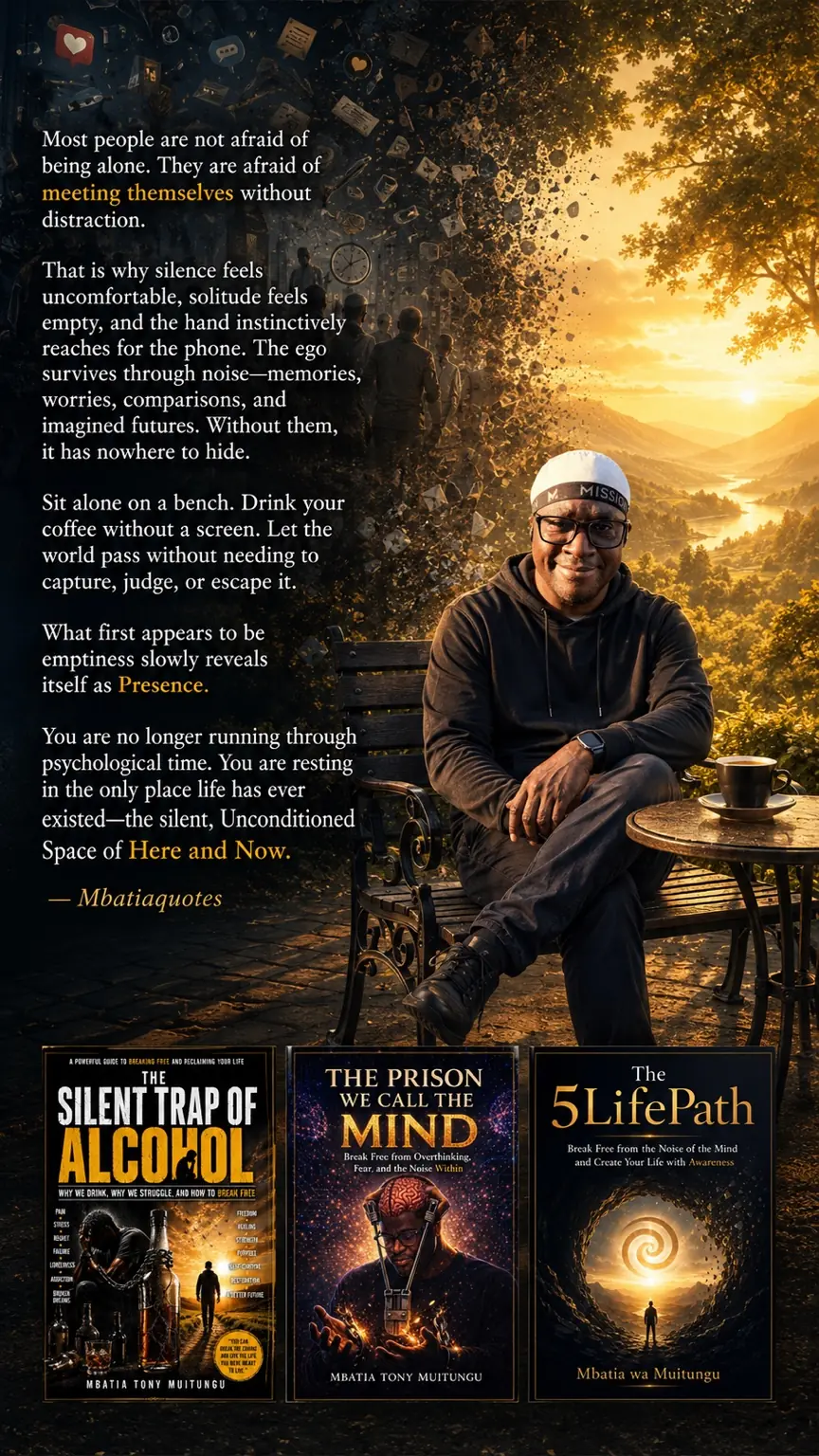
Sit on a bench without your phone. Drink coffee without watching a screen. Drive occasionally without filling the car with sound. Take a walk without photographing or posting it. Allow an experience to belong entirely to you.
At first, the mind may protest. Let it. You do not need to silence your thoughts by force. Simply notice them without following every story they create. Notice the urge to reach for distraction. Feel the sensations beneath that urge. Remain curious instead of judgmental.
Ask yourself, “What is this moment trying to show me?”
Over time, the discomfort begins to loosen. You become less frightened by passing emotions because you learn that feelings can move through you without defining you. You become less controlled by thoughts because you recognize that awareness is larger than whatever the mind is saying.
You stop abandoning yourself whenever the inner world becomes uncomfortable. That is one of the deepest forms of self-respect.
The Gift Waiting Inside Solitude
Solitude does not separate you from life. It restores your ability to experience life directly.
It clears the inner noise that prevents you from hearing your own wisdom. It reveals the beliefs operating beneath your choices. It teaches you that your peace cannot permanently depend on the availability, approval, or behavior of another person.
Most importantly, solitude introduces you to a version of yourself that does not need to perform.
Beneath the memories, roles, fears, ambitions, and unfinished stories, there is a quiet Presence that has been observing your entire journey.
It is not asking you to become perfect. It is asking you to stop running long enough to recognize it.
Perhaps the fear of solitude is not really the fear of being alone. Perhaps it is the fear that, without noise and distraction, the identity we have worked so hard to maintain may begin to dissolve.
But what dissolves in true Presence is not who you are. It is only who you thought you had to be.
And what remains is not emptiness.
What remains is awareness—silent, whole, and fully alive in the only place life has ever existed: Here and Now.
— Mbatia Muitungu
A Voice of Awareness in a Noisy World