There was a time when human beings did not know that it was 7:30 in the morning.
They knew that darkness was giving way to light. They knew when the rains were approaching, when the land was ready for planting, when certain animals migrated, and when the cold season was returning. Life moved through rhythms rather than schedules. Nature communicated through sunrise and sunset, hunger and fatigue, birth and death, growth and decay.
The movement existed, but the numbers did not.
A river flowed without counting its journey. A tree aged without knowing its age. The moon passed through its phases without calling one day Monday and another Friday. Nature changed constantly, but it did not appear to experience itself as late.
Then the human mind did something extraordinary: it began measuring change. We observed shadows, studied the stars, followed the sun, divided days into hours, and arranged those hours into increasingly precise units. Eventually, we created clocks capable of measuring fractions of a second. What began as an observation of nature became a system for organizing civilization.
It was a remarkable achievement. Time allowed communities to coordinate activities. It helped farmers anticipate seasons, navigators cross oceans, doctors administer treatment, workers organize labor, and societies preserve knowledge across generations. Without measured time, much of the modern world could not function.
But something happened along the way. Humanity created the clock—and then gradually began living inside it.
When Measurement Became Identity
At first, time measured movement. Eventually, it began measuring human worth. We began using it to judge whether our lives were unfolding correctly.
By a certain age, a person is expected to finish school. By another age, they should have found a career, married, bought a home, raised children, accumulated wealth, and secured the future. If these events do not happen within the socially approved period, the mind begins to whisper: “I am falling behind. I have wasted too many years. Everyone is moving faster than I am. It may be too late for me.”
These statements sound factual, but most are psychological interpretations. Behind whom are we falling? Late according to whose clock? What universal law determines the correct age at which a human life must discover its purpose?
The clock can tell you how many years have passed since your birth. It cannot tell you whether those years were meaningless. A calendar can tell you the date. It cannot determine whether you are ready to love, begin again, change direction, create something meaningful, or finally understand yourself.
A person may spend years trying to catch up with an imaginary version of life—one created from cultural expectations, family conditioning, comparison, and fear. Even success can become joyless because the person is no longer living; they are trying to arrive on schedule.
The Two Experiences of Time
There is a necessary distinction between practical time and psychological time.
Practical time belongs to responsibility. It helps us keep appointments, take medication at the correct hour, arrive at work, complete projects, honor commitments, and prepare for future needs. If you have a flight tomorrow morning, ignoring the clock will not make you more conscious. It will simply make you miss the flight.
Practical time is not the enemy. It is intelligence applied to daily life.
Psychological time is different. It begins when the mind uses the past and future to create a continuous state of inner suffering. You may need only a few minutes to plan for tomorrow, but the mind can spend the entire night rehearsing it. You may need to remember a past mistake long enough to learn from it, but the mind can repeat the event for years, keeping guilt alive long after the situation has ended.
The appointment is practical. The endless worry surrounding it is psychological. The deadline is practical. Believing your entire identity depends on meeting it is psychological. Remembering the past is practical when it offers wisdom. Repeatedly returning there to punish yourself is psychological.
Memory can become regret. Imagination can become anxiety. Planning can become obsession. Ambition can become permanent dissatisfaction. Time can become a prison with no visible walls.
The Body Is Here While the Mind Is Elsewhere
The past no longer exists as a present event. It exists as memory, consequence, and interpretation. The future does not yet exist as an experience. It exists as possibility, imagination, and projection.
Yet the body responds to these mental images in the present. A person may be sitting safely in a quiet room while mentally reliving a painful conversation from ten years ago. Nothing is physically happening, but the heart begins to race. The muscles tighten. The nervous system responds as though the event has returned.
Another person may be lying in bed imagining something that could happen next month. The feared event has not occurred and may never occur, yet the body begins experiencing its emotional consequences tonight.
Thought can travel backward and forward through time. The body cannot. The body experiences every remembered past and imagined future now.
The Culture of Hurry
Modern society does not merely use time. It worships speed. Faster is considered better. Busyness is mistaken for importance. Exhaustion is worn like evidence of ambition. Rest must be earned, silence must be filled, and every unoccupied moment becomes an opportunity to check a screen.
We eat quickly because there is work to do. We postpone exercise because there is no time. We shorten sleep so we can accomplish more. We give partial attention to the people we love because the mind is already preparing for the next obligation.
The tragedy is not simply that we have become busy. The deeper tragedy is that many people are absent from their own lives while performing them.
They are physically eating but psychologically attending tomorrow’s meeting. They are sitting with family but mentally answering unfinished messages. They are walking through a beautiful place but thinking about the photograph they will post afterward. They are celebrating an achievement while worrying about the next one.
The moment is repeatedly treated as a bridge to somewhere more important. But when the future arrives, it arrives as another present moment—and the conditioned mind turns that moment into another bridge. In this way, a person can spend an entire lifetime preparing to live.
The Violence of Comparison
Measured time becomes particularly painful when combined with comparison. Someone else’s marriage becomes evidence that we are alone. Their home becomes evidence that we are behind. Their career becomes evidence that we chose incorrectly. Their success makes our own unfolding feel too slow.
But comparison removes context. We see the achievement but not the sacrifices, advantages, wounds, private struggles, or circumstances behind it. We compare our inner uncertainty with someone else’s public presentation and then call the conclusion truth.
Life does not move according to a single schedule. Some people discover their calling early. Others must first survive, raise families, recover from loss, confront their conditioning, or walk through experiences that later become the foundation of their work.
A seed beneath the soil may appear inactive, but hidden growth is still growth. Not every important season is visible.
The Promise of “One Day”
Psychological time often hides inside a seemingly hopeful phrase: “One day.” One day I will rest. One day I will be peaceful. One day I will spend more time with my children. One day I will take care of my body. One day I will begin creating.
“One day” can represent a genuine intention. But it can also become the mind’s favorite method of postponement. Peace is moved into the future so that today’s inner conflict does not have to be examined.
Existence does not wait for our conditions to become perfect. Children grow. Bodies age. Relationships change. Opportunities close. People we expected to see again disappear. The ordinary moments we considered interruptions later become the memories we wish we had entered more fully.
The future is not wrong. It is simply incapable of being lived. When tomorrow comes, it will be experienced as now.
The Fear Beneath Our Obsession With Time
Behind humanity’s preoccupation with time lies a deeper recognition: physical life is temporary. This awareness can make life precious. It can encourage us to love more honestly, choose more carefully, and stop postponing what matters.
But when filtered through fear, it creates urgency without presence. We begin running because we know life is short, yet the running prevents us from experiencing the life we are trying to preserve. We fear losing time so intensely that we lose our connection with the present.
The clock did not create mortality. It gave us a visible way to count our movement toward it. But the length of a life and the depth of a life are not the same thing.
Time Is Useful Until It Has Completed Its Work
The answer is not to throw away the clock or abandon planning. Awareness does not require irresponsibility. We need time when practical action is required—to honor another person’s schedule, prepare for an appointment, complete meaningful work, care for our health, and protect what matters.
Time deserves attention when it helps us act. But once its practical work is finished, continuing to think about it does not necessarily add value.
If you have prepared for tomorrow’s appointment, repeatedly imagining it may no longer be preparation. It may be anxiety. If you have learned from a mistake, continuing to condemn yourself may no longer be reflection. It may be self-punishment. If you know the next step, thinking about all fifty steps at once may be resistance disguised as productivity.
If action is possible, act. If no action is possible, the mind does not need to keep carrying the situation.
Returning the Clock to Its Proper Place
Freedom from psychological time does not mean forgetting the past or refusing to prepare for the future. It means placing both within awareness.
The past can be consulted without becoming your residence. The future can be planned without becoming your emotional home. The clock can organize your activities without determining your inner state.
When the mind says, “I am behind,” ask, “Behind whom?”
When it says, “I wasted those years,” ask, “What did those years teach me?”
When it says, “I do not have time to rest,” ask, “What will constant exhaustion eventually cost me?”
When it says, “I will live when I finally arrive,” ask, “What part of life am I refusing to experience now?”
Let the calendar contain your responsibilities, not your identity. Let the past provide wisdom, not a permanent sentence. Let the future provide direction, not continuous fear.
Protect sleep, movement, nourishment, silence, and human connection with the same seriousness that you protect work. These are not distractions from life. They are part of life.
Whenever the mind disappears into imagined time, return through something immediate: one conscious breath, the sensation of your feet touching the ground, the face of the person speaking to you, the taste of your food, or the simple recognition that you are here.
Not yesterday. Not tomorrow. Here.
The Timeless Now
Time is a magnificent human tool, but it is not the substance of life. A clock can measure the duration of a conversation, but not its intimacy. It can measure the years of a relationship, but not its love. It can record the length of a human life, but not the presence, courage, and awareness experienced within it.
Life is not encountered in hours. It is encountered in moments of consciousness.
Use thought when thought is needed, and then allow the mind to become quiet. Use time when time is useful, and then return the clock to the wall.
Plan for tomorrow, but do not relocate your life there. Learn from yesterday, but do not continue living inside it. Give the future direction without giving it your peace.
The most precious moment is not waiting somewhere ahead. It is not hidden in the life you should have lived. It is this moment—the only place where you can breathe, choose, create, forgive, love, rest, and begin again.
Humanity learned how to count time with extraordinary precision. Perhaps our next evolution is learning when to stop counting—and start living.
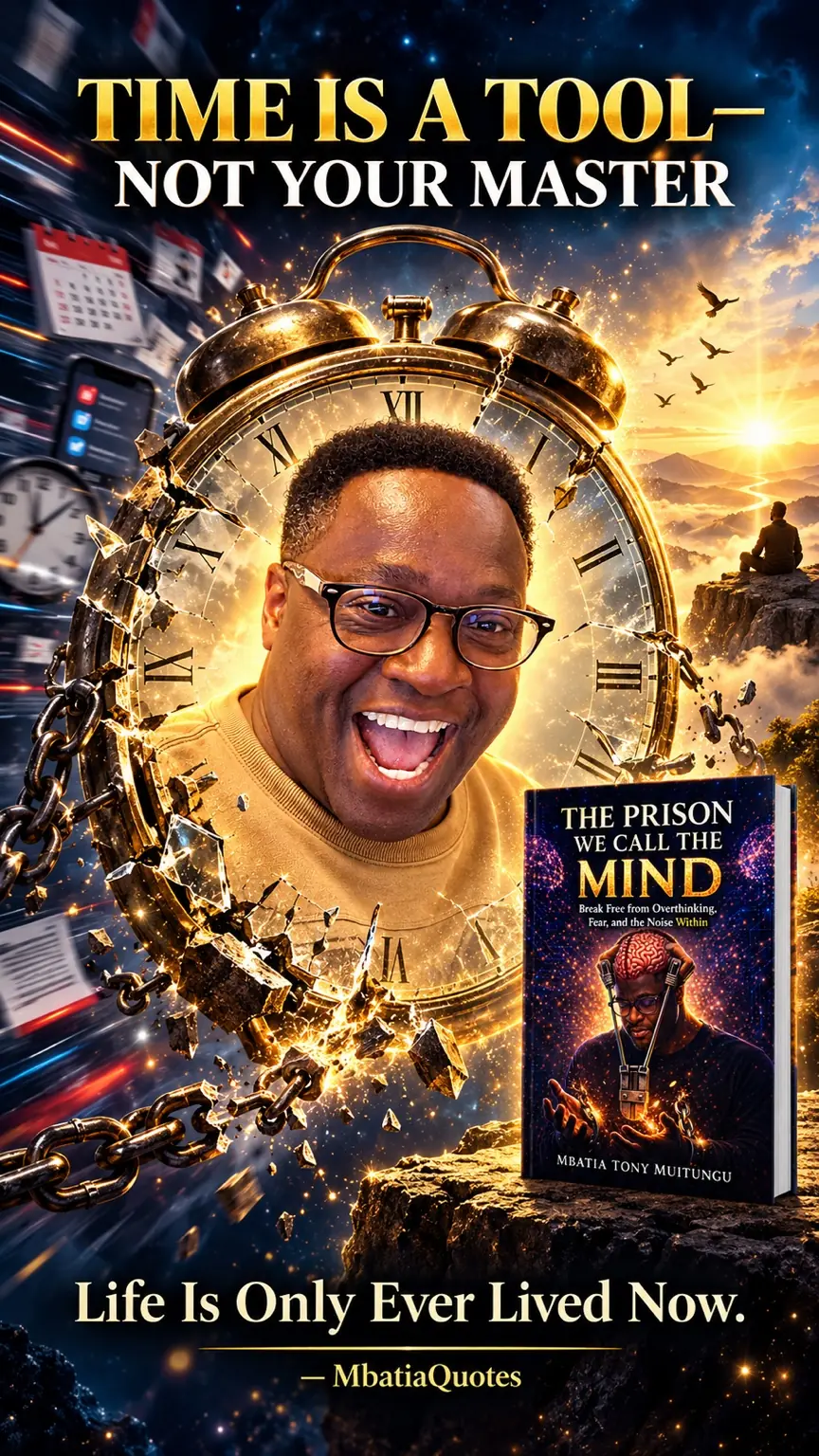
Time is a tool. Use it wisely, but never allow it to convince you that life exists anywhere other than now.
— MbatiaQuotes